 中文繁体
中文繁体
 English
 Français

Piyao Bracelet Buying Guide: Materials, Wearing Rules, and What to Check
A customer turns a beaded bracelet over twice in their hand and asks the one question that matters to them: which way should the head face? That single question holds most of the confusion surrounding the piyao bracelet, and most of what gets answered badly at the counter. The short version comes first. A piyao bracelet is a beaded wrist piece built around the Pixiu, the mythical beast in Chinese folk belief that is said to gather wealth and keep it. It is a symbolic object rather than a financial instrument, and the details that decide whether you still wear it in three years are the unglamorous ones: bead diameter, cord quality, carving depth, total weight, and how the material feels against skin for eight hours a day.
What follows is what buyers usually need before they pay, whether they are choosing one bracelet as a gift or specifying a few hundred pieces for a shop shelf.
What a Piyao Bracelet Is, and What It Is Not
The Pixiu is usually described in folk tradition with a dragon's head, a lion's body and wings. The story that drives its popularity is simple: it is said to feed on gold and silver and, having no anus, to release nothing. That image, rather than any temple text, explains why the creature sits on so many wrists, cash drawers and shop counters. In Feng Shui practice it also appears as a protective symbol.
It helps to separate the layers. The bracelet is culture, not contract. No carving guarantees a return, and a well-made bracelet is simply a well-made bracelet with a story attached. What is genuinely variable is construction, and there are three common builds:
- A single Pixiu figure as the centrepiece, flanked by beads of equal diameter.
- An all-bead strand with one small Pixiu bead worked into the pattern.
- A pendant style, where a figure or charm hangs from a cord or chain joined to a clasp.
Each build has a different weak point. Centre figures catch on sleeves, all-bead strands live or die by cord tension, and pendant styles depend entirely on the link or clasp holding the weight.
Wearing Rules, Head Direction and Fit
Most written guidance says the left wrist is the receiving side and that the head should face outward, away from the body and toward the fingers, so the creature collects from the world rather than from you. Traditions disagree on both points, and direction is often said to be settled once and left alone. Treat consistency as the practical compromise: choose an orientation, then stop adjusting it every morning.
Fit is where tradition gives way to arithmetic. Measure the wrist just behind the wrist bone, then add 1.0 to 1.5 cm for a comfortable beaded strand. Elastic bracelets should slide over the bone without pinching and without leaving a mark after an hour. Bead size changes the character of the piece:
- 6 mm reads as delicate and suits narrow wrists.
- 8 mm is the unisex default and the easiest to rethread.
- 10 to 12 mm makes a statement and weighs noticeably more.
If you wear a watch on the same wrist, metal cases and hard beads will abrade each other. Smooth beads help, separate wrists help more.
Materials Compared: What You Are Actually Paying For
Price differences of five times or more between two visually similar bracelets almost always come from material, not from the shape of the creature. The table below compares what the common options feel like, how they age, and what to verify before paying.
| Material | Feel and weight | Everyday durability | What to verify | Best suited to |
|---|---|---|---|---|
| Jade (nephrite or jadeite) | Cool and dense; an 8 mm strand commonly sits between 20 g and 30 g | Resists daily wear but chips on hard impact | Dye treatment, waxing, and tone uniformity along the strand | Formal gifts, keepsakes |
| Obsidian | Glossy black, mid-weight, warms slowly | Solid body, but thin edges chip | Natural volcanic glass versus black synthetic; look for flow lines and small gas bubbles | Everyday unisex wear |
| Gold or gold-plated silver | Heaviest per volume; feels cold then warm | Solid gold lasts; plating wears at contact points | Karat, or plating thickness in microns; 1 to 3 microns is a reasonable minimum | Dress wear, heirloom pieces |
| Crystal quartz | Cool, clear, moderate weight | Scratches less than glass, chips at facet edges | Clarity, treatments, and bead-to-bead size consistency | Delicate, modern styling |
| Sandalwood and other woods | Lightest option; warms quickly with body heat | Swells and cracks if soaked; surface oils fade | Species, moisture content, and finish type | Casual daily wear, sensitive skin |
| Colored crystal glass | Light for its size; a 10 mm strand often lands near 25 g to 35 g | Holds colour and glaze well; thin edges chip | Lead-free composition, annealing quality, colour consistency across a batch | Statement colour, gifting, retail ranges |
Six Checks Before You Pay
- Bead diameter. Measure the widest and narrowest beads on the strand. Roughly plus or minus 0.5 mm is normal in hand-finished work; a full millimetre of drift looks sloppy on the wrist.
- Cord and knot. Elastic should be 0.8 to 1.0 mm, doubled, with the knot recessed inside a bead rather than sitting on the outside. Expect to restring every 12 to 18 months.
- Carving versus moulding. Look at claws, fins and eyes. Carved figures show slight asymmetry and crisper negative space; moulded copies look soft in the same places.
- Weight. A hollow glass figure feels suspiciously light for its size. A hollow bead strand loses shape quickly under tension.
- Skin contact. Nickel in cheap metal spacers is the most common cause of itching. Steel, titanium, glass and wood are safer for sensitive skin.
- What comes in the box. A spare length of cord and a storage pouch cost the seller almost nothing and tell you they expect the piece to be worn, not displayed.
Where Colored Crystal Glass Fits
Glass allows things stone does not. A single figure can carry gradient glaze from amber into blue, combine frosted and polished zones, and hold saturated colour without the price of treated jade. It is also lighter, so a 12 mm strand does not feel like a burden by mid-afternoon. Because figures are moulded and then carved and glazed, fine detail such as scales, manes and fins survives at small scale. The way colour and transparency are built into a piece is closer to art glass than to stone cutting, a point covered in this overview of crystal decoration, which is worth reading if you care about how light moves through a finished bead.
Batch consistency is the real test. Colour drift between production runs is normal in small workshops and rare in factories that anneal and glaze in controlled cycles, which is why the maker matters more than the material name on the label.
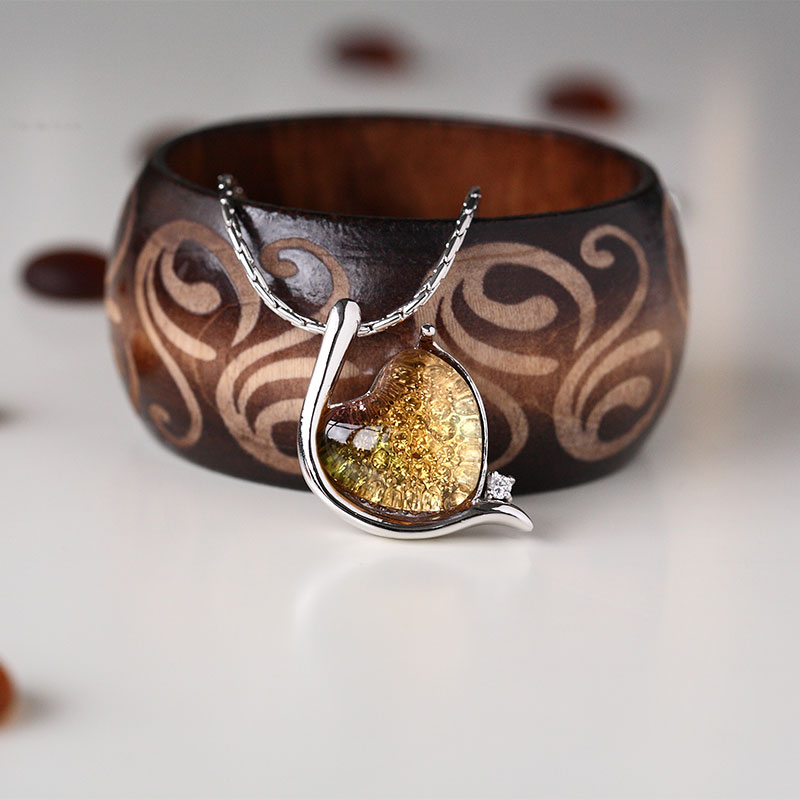 Elegant Silver-Tone Bracelet with Inlaid Glass PendantA silver-tone chain bracelet with an inlaid glass pendant, offering a colour-led alternative to jade or obsidian with elegant sparkle and dreamy, deep-toned luster.View Product →
For buyers who want a colour-led alternative to jade or obsidian, a silver-tone strand with a glass pendant element gives the same silhouette with far more freedom in tone.
Beyond the Wrist: Desk and Counter Pieces
Many people who wear a piyao bracelet also keep one wealth symbol where money is actually handled: a shop counter, a cash drawer, a home study. The golden toad is the most common companion piece, usually placed facing into the room rather than toward a door, and kept away from bedrooms and bathrooms. One or two pieces is enough. A shelf crowded with fortune symbols reads as decoration rather than intention, and it makes the story harder to tell when a guest asks about it.
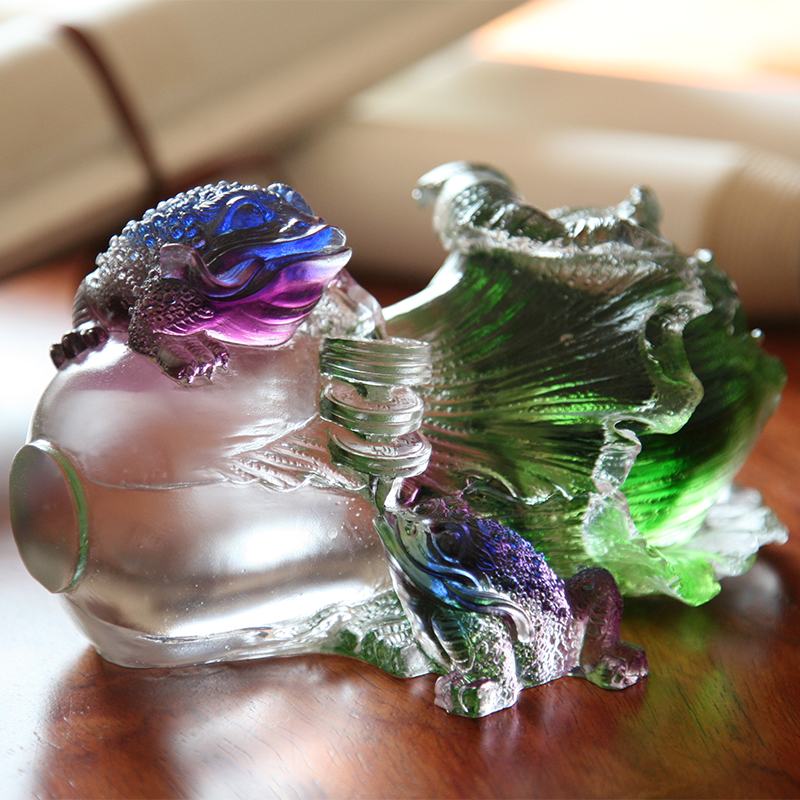 Crystal Glass Golden Toad Sculpture with Cabbage OrnamentA colored-glass golden toad with a green cabbage, suited as a small wealth symbol for a shop counter, cash drawer, or home study.View Product →
A small sculpture in the same material family as the bracelet keeps the pairing visually calm, and it gives a shop or studio a story to explain rather than a random ornament to dust.
Care, Cleaning and Cord Replacement
Most damage to beaded bracelets happens in three places: water, heat and the cord itself.
- Clean with lukewarm water, a drop of mild soap and a soft brush, then dry with a lint-free cloth.
- Skip ultrasonic cleaners on any piece with glued, foiled or adhesive-mounted elements.
- Avoid sudden temperature change with glass and crystal; thermal shock cracks beads that survive years of normal wear.
- Remove the bracelet before swimming, showering and training. Chlorine, sunscreen and sweat degrade elastic quickly.
- Store flat in a pouch rather than hanging it, so the cord is not under constant tension.
Restringing is maintenance, not repair. If the cord has stretched to the point where gaps open between beads, replace it before it fails in public.
For Retailers and Gift Buyers: Write the Specification
When an order runs to hundreds or thousands of pieces, the failures are predictable: colour drift between batches, diameter drift within a strand, and cord that was never specified. Put the numbers in writing. Bead diameter with tolerance, bore size, cord type and thickness, knot position, plating thickness in microns, figure height, and packaging format. Ask for a pre-production sample, approve it, then keep it as the reference for the whole run.
It also pays to ask who controls the finishing. JM-ARTFAMILY, a glass art maker based in Kunshan, Jiangsu, has produced colored crystal glass pieces since 2001 and works across ornaments, jewellery and temple supplies, with colour and glaze finishing done in its own workshop. That kind of vertical control is what makes a repeat order look like the first one rather than a near match.
A piyao bracelet is a small object carrying a large story. Buy the part you can verify, which is material, carving, cord and fit, and treat the symbolic layer as culture rather than promise. Choose a size you will actually wear daily, check the construction before you pay, and the piece will still be on your wrist long after the packaging is gone.
 previous post