 中文繁体
 English
 Français

Buddha Decoration Guide: Crystal Glass Statues, Altar Sets and Placement
A 28 cm crystal Buddha on a hallway console can set the tone for everything around it. The same figure squeezed onto a bookshelf between paperbacks and a coffee mug quietly disappears. Buddha decoration is decided far less by taste than by three practical things: where the piece will stand, how far away people actually stand from it, and what light reaches it through the day. Get those right and almost any finish looks considered; get them wrong and even expensive carving reads as clutter.
The notes below run from a single shelf ornament up to a temple altar or a full wall of glazed bricks, with the measurements, materials and handling details that tend to matter at each scale.
Choose the Position Before the Piece
Walk the room and notice where people pause. A figure at the end of a corridor is seen head-on, briefly, from two or three metres. A figure beside a sofa is seen from the side at close range, often by someone sitting down. Those two positions ask for different pieces.
Face and hands carry most of the expression, so the figure should read from the front or a slight three-quarter angle. Shelves above eye level force an upward view that hides the base and the lotus seat. Low consoles in a seating area work best when the top of the figure sits near, or just below, standing eye level.
Positions that usually disappoint
- Directly in front of a window: strong backlight turns a translucent figure into a silhouette and flattens the face.
- Bathrooms and kitchens: steam and cooking grease film a polished surface quickly and are awkward to lift without marking it.
- Narrow circulation routes: a solid crystal piece at hip height is a genuine knock-over risk in a busy household.
- Crowded shelving: three objects of similar size in one line compete, and none of them wins.
How Crystal Glass Behaves in a Room
Crystal and liuli glass transmit light, which is why a small figure in this material so often looks larger and more present than a bronze or resin piece of the same height. Colour is generally built in with coloured glaze during forming, frequently as a gradient from a deep base to a paler upper body, or with frosted passages that scatter light instead of reflecting it. In daylight the edges glow; under a warm table lamp the same piece turns heavier and more amber. The studio's notes on crystal decoration as a play of light explain that shift in more detail.
Two practical consequences follow. First, polished surfaces mirror whatever stands in front of them, including window frames and lampshades, so a matte or lightly frosted area on a robe or base keeps the face readable. Second, translucent material rewards a simple backdrop, such as a plain wall or a single dark panel, far more than a busy patterned surface. A pale figure on a pale wall needs a shadow gap or a darker plinth to separate it from the background.
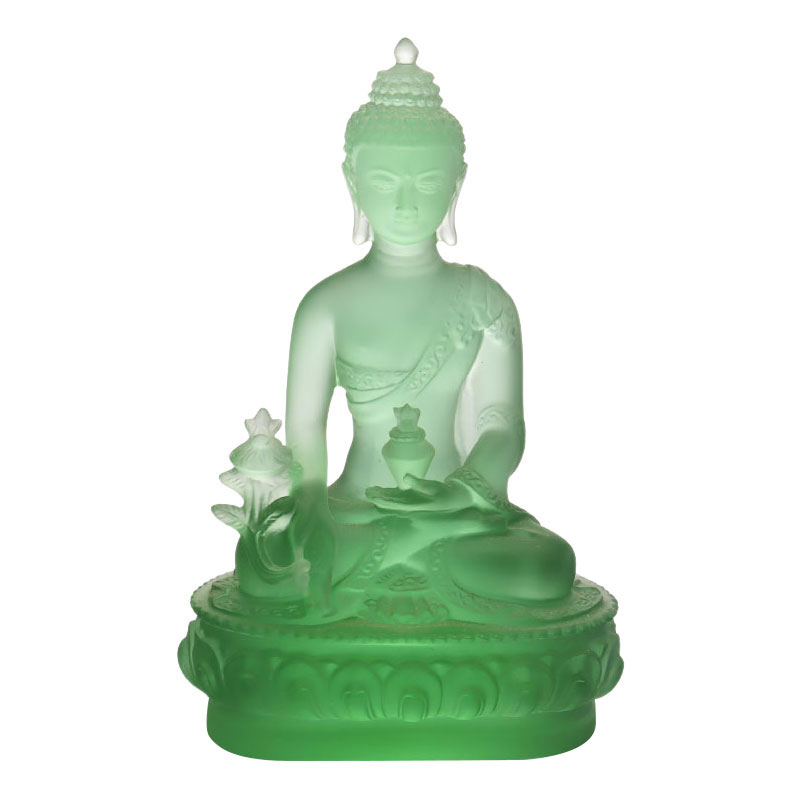
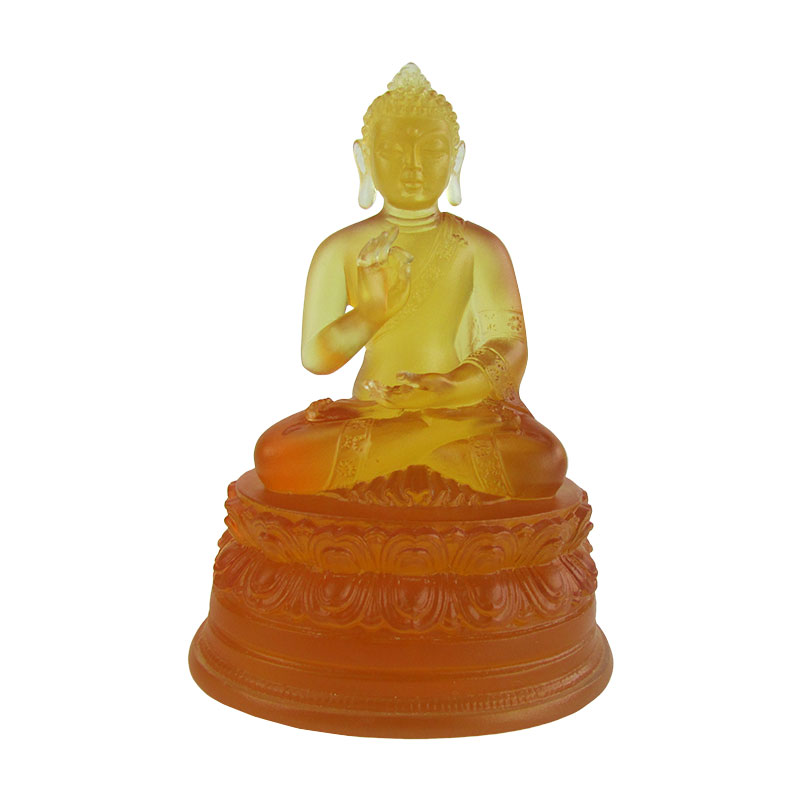
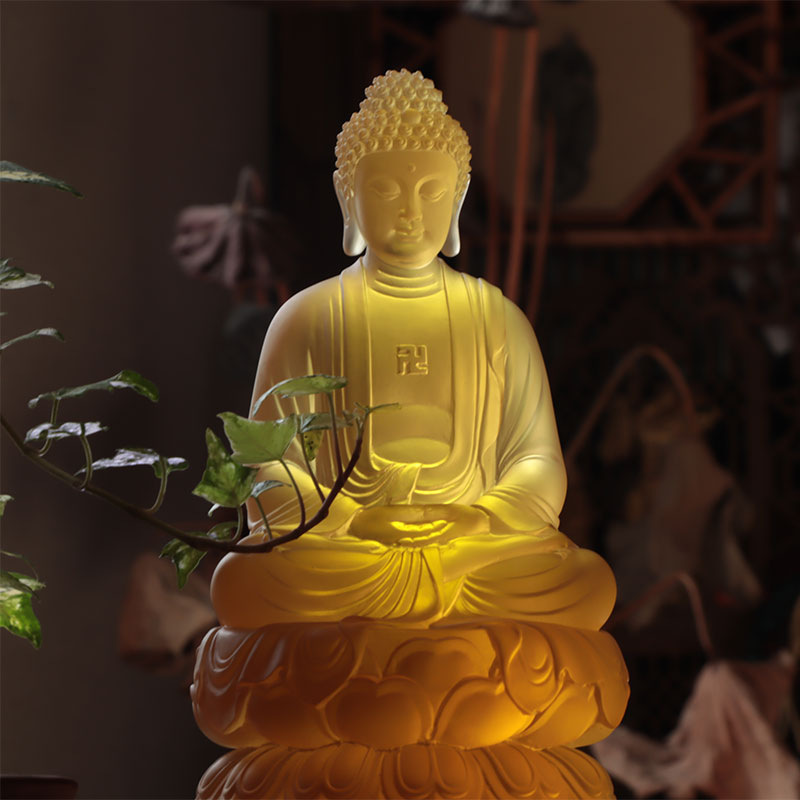 Amitabha Buddha Crystal Statue for Devotional DisplayA crystal Amitabha Buddha statue symbolizing infinite light and life, suited to a simple devotional display where material and backdrop remain readable.View Product →
Seated figures with a defined lotus base tend to sit more convincingly on a plinth, because the base already reads as a horizontal line and echoes the shelf edge rather than floating above it.
Sizing by Viewing Distance
Height is the first number buyers ask about and the least useful on its own. What matters is the ratio between figure height and viewing distance: a 20 cm piece seen from 60 cm fills the eye almost the same way a 60 cm piece does from 2 m. Too small and the detail of the carving is lost; too large and the room feels like a showroom.
| Setting | Figure height | Typical viewing distance | What to watch |
|---|---|---|---|
| Entry console or sideboard | 20-30 cm | 1.5-2.5 m | Keep the top of the figure near standing eye level |
| Built-in shelf or alcove | 25-40 cm | 0.8-1.5 m | Leave 5-8 cm of clear space above a crown or halo |
| Low table in a seating area | 15-25 cm | 0.5-1 m | Test the sightline from a seated position, not standing |
| Temple hall or large altar | 50-120 cm | 3 m and beyond | Plan a plinth and confirm floor loading before delivery |
| Glazed wall panel | 60 x 90 cm and larger | 1.5-3 m | Light from above at a shallow angle to catch the relief |
Allow for the base as well. A carved plinth or wooden stand adds 5-10 cm and changes the proportions of everything above it, so measure the total finished height rather than the figure alone.
Altar Sets: Figure, Offerings and Symmetry
On a home altar, the figure is only half the composition. Offering sets are usually built around a repeating emblem: the eight treasures, the eight auspicious symbols, a lotus series or a ruyi series, each rendered as a small bowl, vase or covered vessel in matching glass. Sets work because the repetition gives the eye a rhythm, and because a single colour family holds the arrangement together when the figure behind it is a different tone.
Three rules cover most installations. Set the figure on the highest tier and keep the offerings clearly lower, so the arrangement reads as an ascent rather than a row. Keep spacing even, usually 8-12 cm between vessels, and keep the count odd where tradition calls for it, with five and seven being the common groupings. Finally, check the colour mix under the light that will actually be used; a blue-glazed offering set that looks cool in daylight can turn grey under a warm bulb.
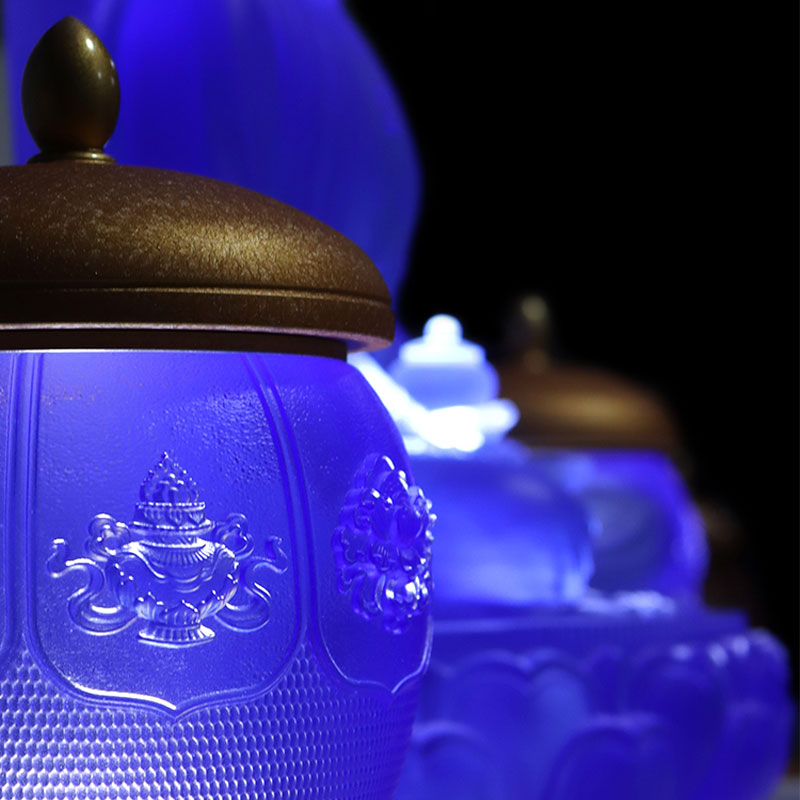 Eight Treasures Lotus Crystal Glass Altar Offering SetCoordinated royal-blue glass altar offering set with carved details and gold accents, useful where matched scale and glaze simplify arranging a Buddhist altar.View Product →
A matched set also simplifies procurement, since the vessels arrive in consistent scale and glaze, which is not guaranteed when pieces are bought individually over time.
Wall Panels, Niches and Larger Installations
In temple and memorial work the decoration is often architectural. Glazed decorative bricks, typically moulded with a Buddha or bodhisattva relief and finished in coloured glaze, are set into a wall as a panel rather than hung as a picture. The practical issues are weight, substrate and light. Each brick is solid glass, so the wall behind it needs a cement board or masonry base with mechanical fixings, not adhesive alone. Joints are usually kept narrow and consistent so the panel reads as one surface.
Lighting transforms these panels. A shallow wash from above at roughly 30 degrees rakes across the relief and picks out the carved lines; straight-on floodlighting flattens them. For niches, alcoves and columbarium racks, the same logic applies at smaller scale: a recess with a light shelf above it and a dark interior behind the figure gives depth that no freestanding shelf can match.
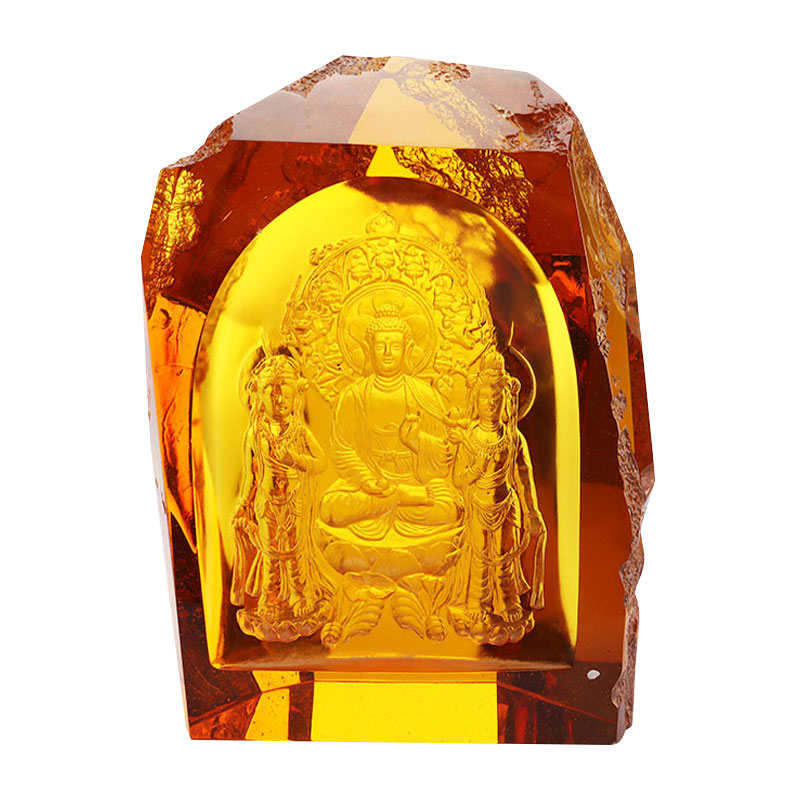
 Amitabha Buddha Liuli Decorative Brick for Temple WallsGolden-toned liuli brick depicting Amitabha Buddha on a lotus seat with carved cloud details, suited to temple wall or niche display.View Product →
Order the full panel quantity in one batch where possible, because glaze tone can shift slightly between production runs and adjacent bricks are always compared side by side.
Cleaning and Handling
Crystal glass is harder than most people expect and more forgiving than ceramic, but the polished edges and thin relief details are where damage starts.
- Dust with a dry microfibre cloth first; wiping a dry surface with a wet cloth simply moves grit around.
- Use lukewarm water with a drop of mild detergent, then buff dry immediately with a soft cloth to avoid water spots.
- Skip ammonia-based cleaners, abrasive pads and ultrasonic baths, all of which can dull glaze or loosen applied colour over time.
- Lift with two hands under the base, never by a halo, arm or crown, and place felt pads underneath pieces that sit on lacquered or stone surfaces.
- Keep a small brush for carved recesses; a cloth pushed into a deep relief can chip a fine edge.
A Short Buying Checklist
- Measure the intended surface, the clearance above it and the standing or seated viewing distance.
- Decide the total height including base, then subtract 5-10 cm for safety margin.
- Check the figure's expression and hand positions from the angle it will actually be seen.
- Confirm the glaze tone under warm light as well as daylight if the room has both.
- Ask how the piece is packed and whether the base is integral or separate.
- For sets and panels, order everything in one batch to keep colour consistent.
Most disappointing purchases come down to a size mismatch or a placement decision made after the piece arrived. Fix the position first, size to the viewing distance, then let the material do the rest. If you are planning a larger arrangement, from a matched altar set to a glazed wall panel, the full range of crystal glass decorations is a sensible place to compare scale, glaze and finish side by side.
 previous post